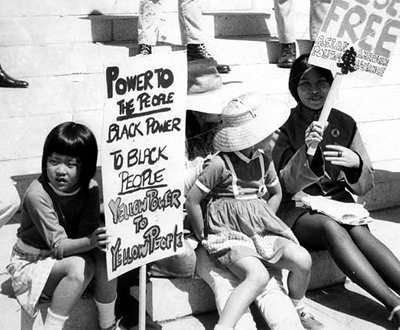
Black Coolness is higher-status than Asian Dorkiness.

''Power to the people. Black power to black people. Yellow power to yellow people.''The Racialicious post, Talking About The Things We Do To Each Other, is an important intra-POC conversation about tensions between black people and (East) Asian people (or rather between non-Asian black people and non-black Asian people). This is an incredibly complex topic, and I will have to respond to this issue through multiple posts.

Firstly, however, I must strongly disagree with Thea Lim’s characterization of East Asians:

I had a long convo with my friend L about this last week, where he said that East Asian students always gravitate towards white students, whereas African American students will usually stick together. The more we talked about it, the more I realised that he thought East Asian students do that because they aspire to whiteness, and because they can – economic privilege or light skin privilege allows them to do so. I was surprised to realise that he didn’t get it – East Asian students gravitate towards white students as a means of protection from the particular kind of racism that East Asians experience; where they are always made to feel as if they are from somewhere else.

Not only does this not apply to me as a (non-black) Chinese Canadian, but this whole situation does not apply to the schools I attended growing up. Perhaps it is a class difference and/or regional demographic difference, but the situation that Thea describes would be impossible at the public schools I attended.

Read the rest of this entry »

Auto-exoticism is Asians performing Chinese New Year for a non-Asian classroom.

Once a year, dmp and her mom performed Chinese New Year for her 98% non-Asian elementary class. Afterward, she went to her grandparents’ house and celebrated Têt, the real New Year’s.

dmp writes:

I learned a new word today. Auto-exoticism (n.): the idea in which the minority culture accepts and internalizes perceptions of itself from the dominant culture. It is performance intended for consumption, it is a sign given to minorities to express their minority status. It is touting Chinese take-out (that isn’t really Chinese) over your family’s home cooking and tossing around fortune cookies (and those weren’t actually Chinese either) and associating yourself with being “Chinese” (even though you aren’t) because it made you more understandable, and calling your family’s most important holiday Chinese New Year because it’s a catch-phrase that everyone understands.

Link: At Home We Called it Têt

(via Who I am When I’m (not) With You)

Racist white man attacked Asian Canadians with pickup truck.

Ontario man jailed for attack on Asian anglers (CBC News):

[A white] Ontario man has been sentenced to two years less a day in jail Friday for attacking a group of Asian anglers and their friends in 2007.

Justice Alfred Stong also sentenced Trevor Middleton, 23, to three years’ probation after he has served his sentence, and 240 hours of community service helping seniors and people with mental disabilities. Middleton will also be required to attend a cultural awareness course, and he’s been banned from driving for 10 years.

According to Justice Stong, since some of the victims were Asian Canadians, what made them stand out visually in the overwhelmingly white town must have been their “culture”, which was made conspicuous by the fact that they were trying to fish from a dock in Lake Simcoe, Ontario, alongside their white friends.

Read the rest of this entry »

White people’s family roots are deeper than those of ethnic minorities.

Another example of white privilege and othering is when white people assume that racialized people have deeper roots and stronger family ties than white people. The othering is based on the notion that “non-white” people are foreign people, and that “non-white” people have a stronger ethnic identity because we are more homogeneous and monolithic in ways of thought. White privilege allows white people to ignore the ways in which a white-majority society encourages only white families to lay down their roots and blossom, while historically, it enacted laws to extinguish and suppress “non-white” and racialized families.

White Americans envy African Americans for having “roots” in “Africa”, while ignoring the fact that Africa is a heterogeneous continent (like Europe), and that most African Americans cannot trace their African ancestry precisely because of white racism and slavery. It is no accident that African Americans are more likely to find documents attesting to the existence of their white ancestors. White Americans whose ancestors have been in the United States for multiple generations are the ones with the deepest roots, the ones whose histories were allowed to be recorded, the ones who own property passed down from generations, when all this was denied to non-white people.

Read the rest of this entry »

The Orientalist Riff is an example of white culture and tradition.

The typical white liberal assumes that non-white people have more “culture” than white people, and may express “envy” as an attempted compliment. Given that white liberals feel that they are denied access to the non-white culture which they “envy”, it is likely that their “envy” is directed at the imagined culture of non-whites, rather than culture (or loss of culture due to white cultural imperialism) as experienced by non-white people.

One example of the white-imagined culture of people of colour is the Oriental Riff, or rather, the Orientalist Riff:

AAAA, G-G, E-E, G.

Read the rest of this entry »

Design a site like this with WordPress.com
Get started